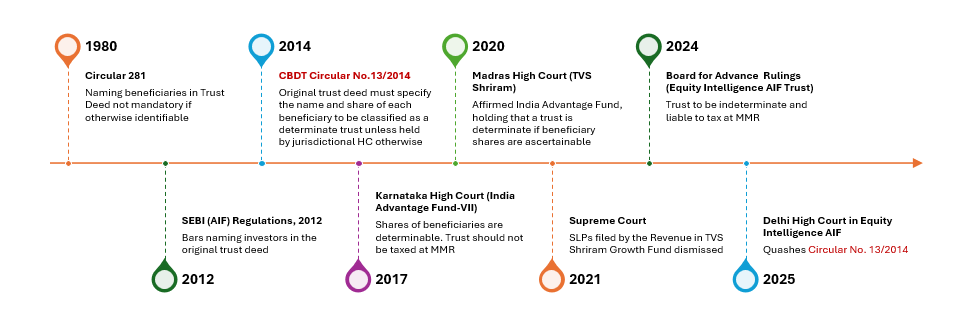
In a landmark ruling, the Delhi High Court has struck down CBDT Circular No. 13/2014 as it applies to SEBI-registered Category III Alternative Investment Funds structured as private trusts. This decision in Equity Intelligence AIF Trust v CBDT & Anr. brings long-awaited relief to the fund industry and has significant implications for fund structuring and taxation going forward.
Partner: Komal Dani, Associate: Himeesha Dhiliwal
For over a decade, Category III Alternative Investment Funds (AIF) structured as private trusts have lived in the shadow of the Central Board of Direct Taxes (CBDT) Circular No.13/2014,1 a single-page clarification that mandated the original trust deed to specify the beneficiaries’ names and shares for the trust to be classified as a determinate trust (2014 CBDT Circular). Paragraph 6 of the 2014 CBDT Circular further indicated that this clarification would not apply to areas falling in the jurisdiction of High Courts that have either already taken or subsequently take a contrary view on the issue. As a result, the 2014 CBDT Circular created uncertainty for the fund industry, and what began as a tax circular came to influence fund structuring, investor-level tax allocation, and the overall compliance approach of the AIF ecosystem. However, the Delhi High Court’s judgment in Equity Intelligence AIF Trust v The Central Board of Direct Taxes & Anr.2 dated 29 July 2025, struck down the 2014 CBDT Circular, signalling a fundamental shift in this legal landscape.
Now that the initial wave of reactions to the judgment has subsided, a more nuanced understanding is emerging across the industry. The broader implications of the judgment, especially concerning the operational and compliance frameworks governing Category III AIFs, are being analysed. The ruling potentially reshapes the expectations placed on investment managers and fund structuring strategies, going forward.
1.The backdrop: An industry caught between SEBI and CBDT
Under Indian tax laws, the way a trust is classified – as either determinate or indeterminate – affects how its income is taxed. If the beneficiaries and their shares are clearly defined (a determinate trust), the income is generally taxed at the rates applicable to those beneficiaries. However, if it is unclear who the beneficiaries are or what their shares will be (an indeterminate trust), the income is taxed at the highest tax rate under the Income Tax Act, 1961 (IT Act), i.e., the Maximum Marginal Rate (MMR).
Simply put, the law is clear that, in principle:
- if beneficiaries are named and their shares are ascertainable on the date of the trust deed, it’s a determinate trust;
- If the beneficiaries are not clearly defined or ascertainable at the time the trust is created, the MMR will apply.
However, the application of this principle to Securities and Exchange Board of India (SEBI)-registered Category III AIFs involves greater complexities. The SEBI (AIF) Regulations 20123 and Section 12 of the SEBI Act, 1992 (SEBI Framework) prohibit a trust from accepting investments or identifying investors until it is registered. This means that AIFs cannot name beneficiaries in the trust deed at the time of its execution. Instead, investors are introduced later, through contribution agreements, and their shares are tracked through Net Asset Value (NAV) statements and fund records.
In theory, this position was considered well established until the 2014 CBDT Circular was issued. This marked a shift from the earlier understanding set out in CBDT Circular No. 281 of 1980, which had accepted that beneficiaries did not need to be specifically named in the trust deed, as long as they could be clearly identified through other reliable means.
2. The 2014 CBDT Circular: The circular that forced the industry to take a conservative view
Issued on 28 July 2014, the 2014 CBDT Circular mandated that both the name and share of each beneficiary be expressly stated in the trust deed itself from inception. If not, the trust would be deemed “indeterminate” and taxable at MMR, regardless of whether the shares of beneficiaries were otherwise identifiable.
Consequently, even well-structured AIFs with clear investor records found themselves exposed to punitive tax treatment due to their inability to name beneficiaries before the AIF is registered under the SEBI Framework.
Taking a cautionary approach, most Category III AIFs began applying MMR to all their income (including capital gains) and computing tax at a flat rate (e.g., 14.95% on long-term capital gains), ignoring the investor-specific slab rates, exemptions, or loss set-offs. This approach, while conservative, was costly.
3. The trigger: the case of Equity Intelligence AIF Trust
Equity Intelligence AIF Trust, a SEBI-registered Category III AIF, decided to challenge the status quo. Though its trust deed did not name individual investors, the fund consistently filed returns as a determinate trust, with investors’ shares identifiable from contribution agreements and NAV.
In 2018, the fund approached the Authority for Advance Rulings (AAR) seeking clarity on its tax treatment, specifically regarding whether it would be classified as a determinate or an indeterminate trust and the resulting tax implications due to such classification. When AAR was abolished in 2021, the case moved to the Board for Advance Rulings (BAR), which, in June 2024, ruled against the fund, relying squarely on the 2014 CBDT Circular and its requirement to name beneficiaries in the trust deed. This ruling was appealed before the Delhi High Court.
4. The battle in court: Invoking the doctrine of impossibility
Equity Intelligence AIF took the matter to the Delhi High Court, arguing that:
- Beneficiaries were always identifiable and their shares determinable, even if not named in the trust deed.
- SEBI Framework made it legally impossible and impermissible to name beneficiaries upfront, and therefore, compliance with the 2014 CBDT Circular was impossible.
- The earlier CBDT Circular 281/1980 (which expressly clarified that it was not necessary for the original trust deed to name all beneficiaries for a trust to be considered determinate) was still valid since it had not been withdrawn or rescinded, and therefore, the 2014 CBDT Circular contradicted this earlier circular.
- The Karnataka High Court (in India Advantage Fund–VII)4 and Madras High Court (in TVS Shriram Growth Fund)5 had already ruled that trusts like these are determinate, and the Revenue had not effectively challenged those rulings.
The Delhi High Court considered and concurred with the above reasoning and, in a decisive ruling, quashed the 2014 CBDT Circular in its application to SEBI-registered AIFs.
5. The Delhi High Court ruling: Key points
- Imposing a requirement that contradicts the SEBI Framework is legally untenable. The CBDT’s position effectively compelled AIFs to violate the SEBI Framework to comply with tax law, an outcome the Delhi High Court deemed unacceptable.
- A trust cannot be declared indeterminate merely because the names of the beneficiaries are not stated in the deed, so long as they are identifiable through legally recognised documentation like contribution agreements and NAV records.
- The BAR ruling of June 2024 was set aside, and the petitioner was directed to be assessed as a determinate trust, not subject to MMR under Section 164 of the IT Act.
6. What happens now?
This ruling potentially reshapes the tax landscape for the entire Category III fund industry. With the Delhi High Court declaring the 2014 CBDT Circular ultra vires, the long-standing basis for applying MMR to SEBI-registered AIFs has been dismantled.
As a result, the confusion created by the 2014 CBDT circular should now be resolved, both because (i) the doctrine of impossibility makes its core requirement legally untenable, and (ii) it should not be selectively applied only in jurisdictions lacking favourable High Court rulings, having been struck down by the Delhi High Court in its entirety.
This is especially significant for non-resident investors such as sovereign wealth funds and global universities, many of whom enjoy tax exemptions in their home countries. With the ruling in place, these investors could see improved post-tax returns on their investments in Indian funds. Investment managers now have strong judicial backing to stop applying conservative MMR taxation and instead assess funds as determinate trusts. The CBDT may be compelled to withdraw or amend the circular to align with court precedents. Past MMR tax payments could also be open to refund claims, potentially unlocking significant recoveries for funds and their investors.
[1] F.No. 225/78/2014 dated 28 July 2014 issued by Central Board of Direct Taxes
[2] W.P.(C) 9972/2024 & CM APPL Nos.40840/2025, 69940/2024 & 1448/2025
[3] Regulation 3, 4, 6, and 7 of the SEBI (Alternative Investment Funds) Regulations, 2012
[4] The Commissioner of Income Tax & Anr. v M/s India Advantage FundVII, 2017 SCC OnLine Kar 6857
[5] Commissioner of Income Tax, Chennai v TVS Shriram Growth Fund, 2020 SCC OnLine Mad 28112
If you require any further information about the material contained in this newsletter, please get in touch with your Trilegal relationship partner or send an email to alerts@trilegal.com. The contents of this newsletter are intended for informational purposes only and are not in the nature of a legal opinion. Readers are encouraged to seek legal counsel prior to acting upon any of the information provided herein.